Also called: bridge bearings, elastomeric bearings, pot bearings, spherical bearings, bearing plinths
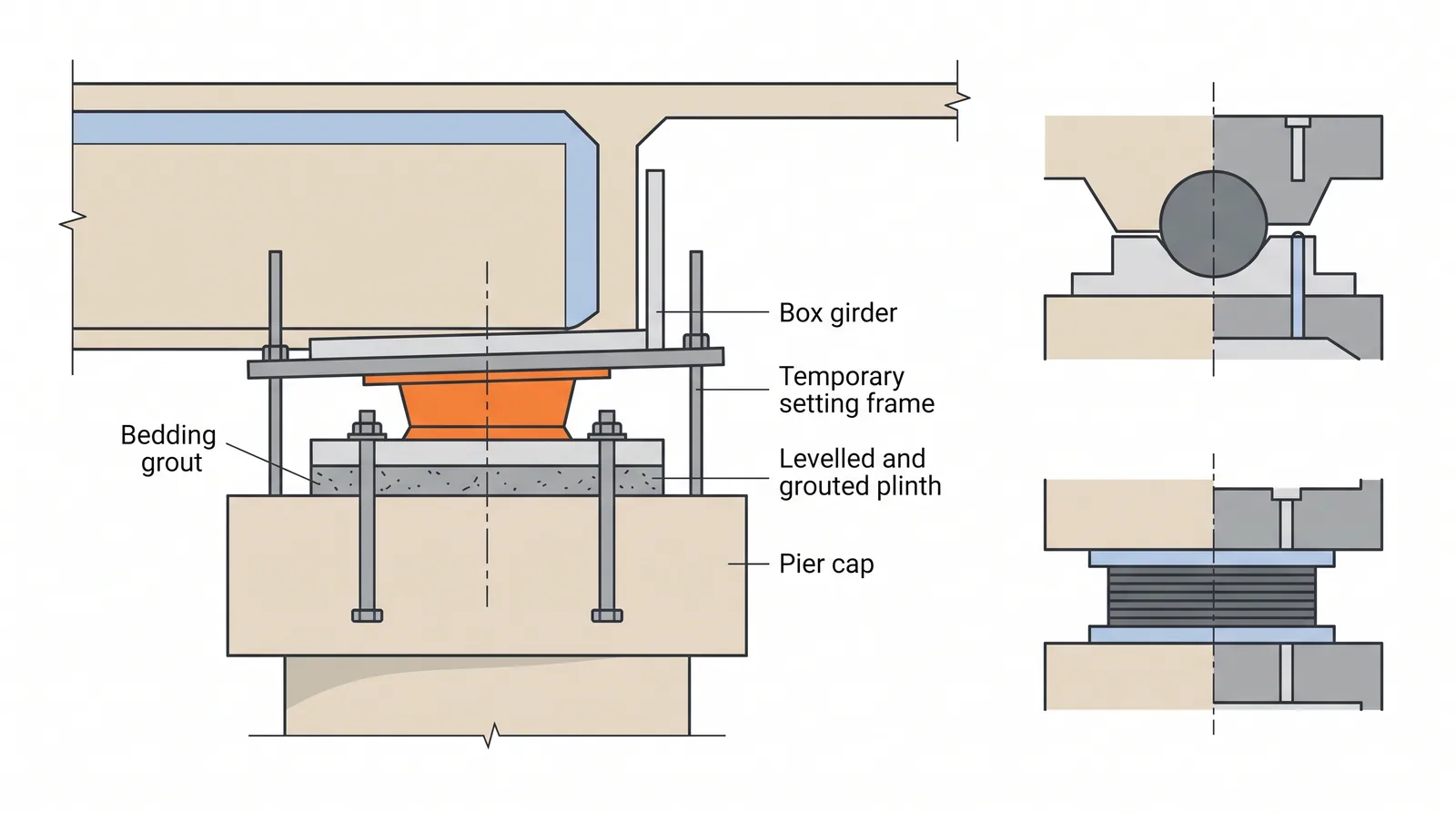
How it is done
- Check the bearing schedule against the drawings before ordering: type, design loads, movement directions and ranges, rotations, guide orientation, pre-set table and the jacking points for future replacement. Receive each bearing with its certificate and store it covered with the transport clamps on.
- Cast the plinth or pier top low by the bedding thickness (typically 25–50 mm), with pockets for the anchor dowels; scabble and clean the surface and survey its level.
- Set the lower plate on levelling screws, wedges or packs, aligned to the bridge axis and to the guide direction, levelled to the specified slope, and with the sliding element offset by the pre-set for the expected installation temperature.
- Grout the bedding and anchor pockets in one operation with a flowable non-shrink cementitious grout (epoxy mortar for thin beds), pouring from one side so air escapes; remove packs that would form hard spots and let the grout reach strength before load.
- Connect the upper plate: cast it into the soffit of an in-situ deck, sealed so slurry cannot reach the sliding surfaces, or seat precast and steel girders on it with tapered plates for grade and camber.
- Release the transport clamps once the deck bears on the bearing and before prestress, shrinkage or temperature can move it. Record the time, deck temperature and measured offset, and correct the pre-set if the temperature has changed.
- Fit movement indicators and identification plates, measure offsets and rotations as built, confirm that inspection access and jacking positions are usable, and put the records in the maintenance file.
Key numbers
- Laminated elastomeric bearings (AASHTO)average service compressive stress about 7–11 MPa; shear deformation limited to about 50 % of total rubber thickness, giving movements up to roughly ±50 mm
- Pot bearingsvertical capacity from about 1 MN to over 50 MN; rotation capacity typically 0.01–0.03 rad
- Spherical bearingsrotations of 0.02–0.05 rad and more, at similar loads to pot bearings
- PTFE on stainless steelfriction about 1–4 % lubricated at service pressure, higher at low temperature and low pressure
- Bedding25–50 mm cementitious grout, or 10–20 mm epoxy mortar; typical setting tolerance ±2–3 mm in level and about 3 mrad in slope (check the specification)
- Seismic isolators (lead-rubber, friction pendulum): isolated period about 2–3 s; design displacements commonly ±150–600 mm, up to about ±1 m on large bridges
Where it fits
- Every non-integral bridge; the game's bearing choice feeds the upkeep score.
Where it does not
- Leaving transport clamps on (locked bearings crack piers), bearings inaccessible for replacement, rocker bearings on new bridges.
Choosing it
- Choose laminated elastomeric bearings over pot or spherical bearings when reactions are a few MN or less and movements and rotations are moderate: they are cheap, need no lubrication and tolerate small setting errors.
- Choose spherical over pot bearings when rotations exceed about 0.01–0.02 rad or are cyclic, for example at the ends of long steel girders or during launching; pot seals wear under repeated rotation.
- Prefer integral or semi-integral abutments to bearings at the ends of bridges up to about 60–120 m long; there is then nothing to replace.
- Choose isolation bearings over fixed and guided bearings in high-seismic zones when the longer period cuts pier and foundation forces enough to pay for isolators and larger joints; isolation helps little on soft soil sites, where long-period motion is amplified.
Plant, pace and money
Risks and controls
What goes wrong
- Misalignment, grout voids under the plate, wrong pre-set, corrosion of steel bearings under leaking joints.
Quality assurance
Bearing certificates and tests, plinth level within 1-2 mm, grout inspection, clamp removal recorded.
Origins
Steel rockers, rollers and sliding plates served until the 1950s; laminated elastomeric bearings and PTFE sliding pot bearings replaced them during the 1960s. Seismic isolation followed: the lead-rubber bearing was developed in New Zealand in the 1970s and the friction pendulum bearing in the United States in the 1980s.
Examples
Pot and spherical bearings on all the game's long spans; elastomeric on short ones.
Case studies
Related methods
Further reading
AASHTO LRFD 14 · EN 1337 · AASHTO Guide Specifications for Seismic Isolation Design · EN 1337-11 Structural bearings: transport, storage and installation · EN 15129 Anti-seismic devices · AASHTO M 251 Plain and laminated elastomeric bridge bearings · NCHRP Report 432 High-load multi-rotational bridge bearings