How bridges get built · Cast-in-place concrete decks · Falsework and temporary works engineering
Also called: temporary works design, falsework check, temporary works coordinator
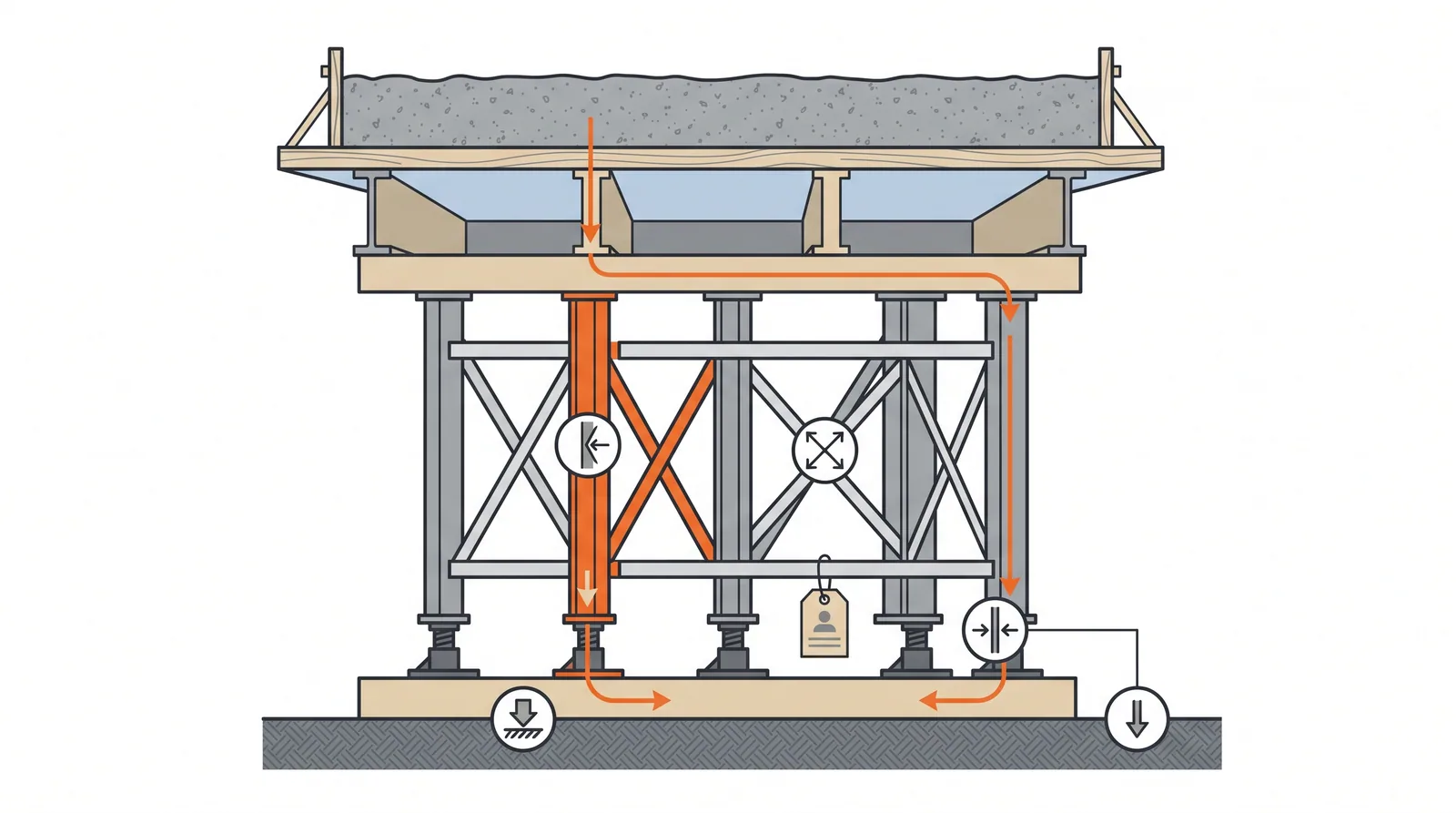
How it is done
- Appoint a temporary works coordinator and keep a register of every temporary structure: falsework, formwork, cofferdams, travellers, gantries and trestles.
- Write a design brief for each item: loads (wet concrete, construction live load, wind, lateral load, pour rate and pump surge), ground information, interfaces, deflection limits and programme.
- Design it, or check the supplier's standard solution against the brief, and have it independently checked at the level its risk requires (BS 5975 check categories 0–3).
- Verify the foundations (bearing, drainage and protection), with plate load tests where the ground is doubtful.
- Inspect the erected structure against the drawings and issue a permit to load (hold point) before any concrete or plant goes on.
- Monitor during loading (tell-tales, settlement and deflection) against stop criteria agreed in advance.
- Issue a permit to strike only when the permanent structure can carry itself (cube or maturity results, stressing complete), and dismantle in the designed sequence.
Key numbers
- Minimum lateral load2.5 % of the vertical load (BS 5975)
- Construction live load on formworkat least 2.4 kN/m2, or 3.6 kN/m2 with motorised carts (ACI 347)
- Minimum combined dead and live design load on formwork: 4.8 kN/m2 (ACI 347)
- Concrete density for designabout 25–26 kN/m3 including reinforcement
- Independent checkcategory 3 (a separate organisation) for complex or novel falsework under BS 5975
Where it fits
- Every project with formwork, falsework, cofferdams, travellers, gantries or trestles.
Where it does not
- Treating the supplier's catalogue as a design; loading before the permit.
Choosing it
- Use the supplier's standard solution with a documented check when loads and geometry are within its tested range; commission a bespoke design with an independent check for heavy, tall, inclined or unusual falsework.
- Put the check in a separate organisation (BS 5975 category 3) when failure would be catastrophic or the design is novel, rather than relying on the designer's own team.
- Prefer ground-bearing falsework only where foundations are verified; on soft or variable ground, piles or preloading cost far less than a collapse or a settlement-damaged deck.
Plant, pace and money
PlantNone; it is procedure and engineering.
ProductivityAdds days of engineering, saves lives.
Cost1-3 % of temporary works cost.
Risks and controls
What goes wrong
- The collapse of falsework, cofferdams and gantries: Willow Island (1978), Injaka (1998), several MSS collapses since 2000.
Quality assurance
Design and check certificates, permit-to-load records, striking release records.
Origins
Systematic temporary works control began in the UK after a run of falsework collapses, including the Loddon Bridge at Reading in 1972, led to the Bragg Committee report (1975), BS 5975 (1982) and the temporary works coordinator role; the FHWA Guide Design Specification for Bridge Temporary Works and ASCE 37 followed in the US.
Examples
BS 5975 in the UK codifies the whole procedure.
Case studies
Sandö Bridge, Ångerman RiverSweden · 1939The timber centering for the 264 m concrete arch collapsed during construction, killing 18 workers; the arch was rebuilt and opened in 1943.
Injaka Bridge, MpumalangaSouth Africa · 1998An incrementally launched deck collapsed during launching with 14 deaths; the inquiry made it a reference case for temporary works design checks and site control.
Related methods
Full staging method (ground falsework)Movable scaffolding system (MSS)Sheet-pile cofferdamForm travellers and traveller anchorageConcrete arch on centering and the Melan (stiff skeleton) methodSelf-anchored suspension bridge erection
Further reading
BS 5975 · ASCE 37 · Temporary Works Forum guidance · Final report of the Advisory Committee on Falsework (Bragg report, 1975) · BS EN 12812 Falsework · FHWA Guide Design Specification for Bridge Temporary Works