Also called: FSM, falsework, conventional cast-in-place, scaffold construction
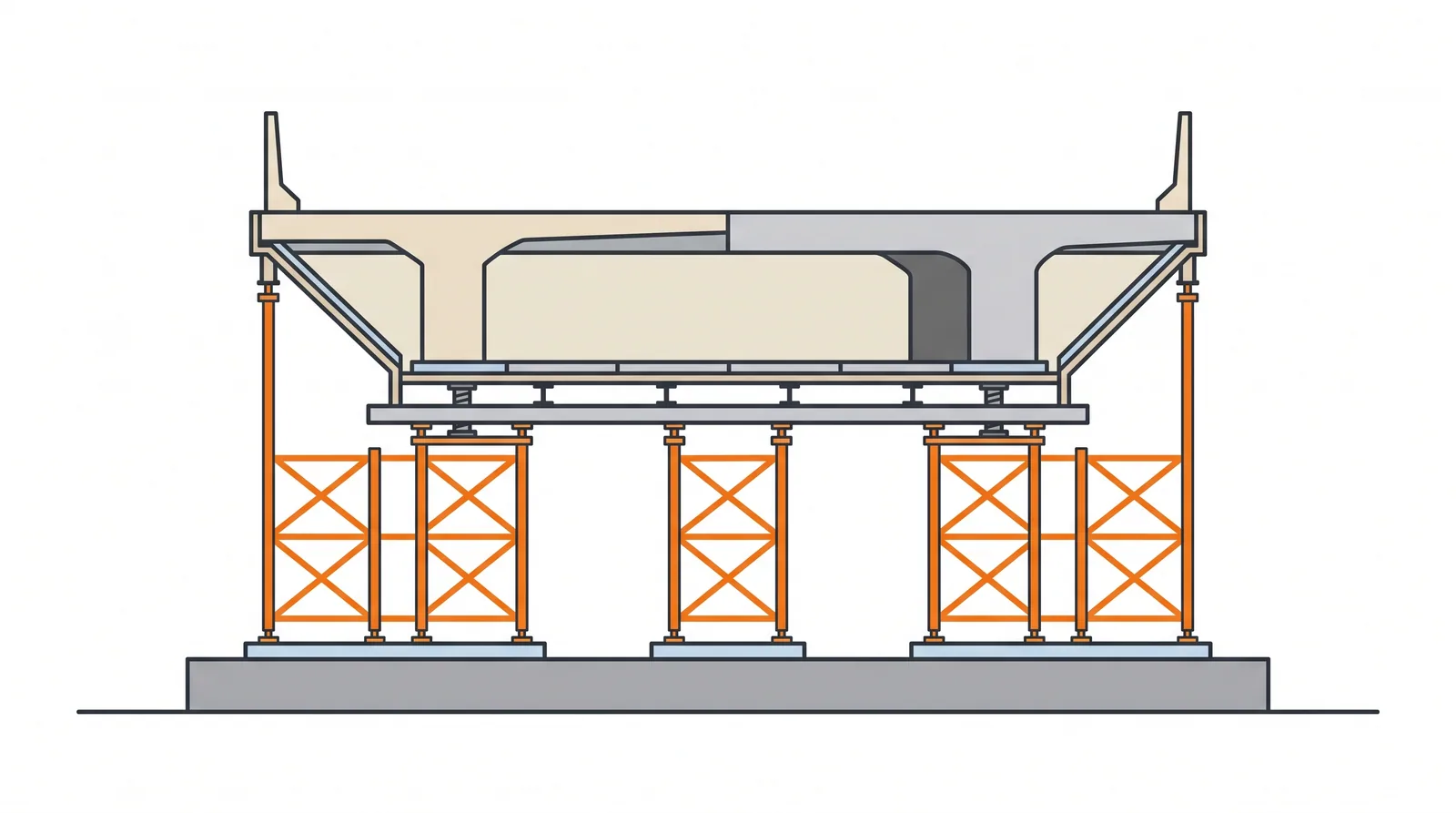
How it is done
- Prepare the temporary works design and its independent check, with ground information for the falsework foundations (plate load tests or a geotechnical assessment).
- Prepare the foundations: a drained, compacted granular platform, concrete strip footings or sleepers, or short piles on soft ground; protect them from washout.
- Erect the towers or props, bracing, primary and secondary beams, and set the soffit to the casting levels: design profile plus deck deflection, falsework shortening and expected settlement.
- On doubtful ground, preload the falsework (water tanks or sandbags) to about the wet concrete load and survey the settlement before fixing the soffit levels.
- Fix reinforcement, ducts and anchorages, inspect them against the drawings and issue the permit to load (hold point).
- Pour in the planned sequence (for boxes, bottom slab and webs first and top slab second; for continuous decks, span regions before support regions), watching settlement tell-tales against agreed stop criteria.
- Cure and stress the tendons at transfer strength, which lifts the deck's weight off the falsework; then release the jacks or wedges from midspan towards the supports.
- Dismantle under a permit to strike and move the falsework to the next span if it is being reused.
Key numbers
- Span10–50 m; deck usually less than about 10–15 m above ground
- Soffit loadabout 15–40 kN/m2 for solid slabs and box decks (concrete 25–26 kN/m3)
- Minimum lateral design load2.5 % of the vertical load (BS 5975), plus wind
- Settlement allowance in the casting levelstypically 5–25 mm on prepared ground
- Cycle30–45 days per span; faster with two falsework sets
Where it fits
- Spans 10-50 m, deck height under about 15 m, dry ground, overpasses closed to traffic below, culvert-type crossings, short valley viaducts.
Where it does not
- Water (the game's crane_ground and falsework checks), live roads and railways below, soft clay under towers, tall decks.
Choosing it
- Choose it over an MSS when spans are few (under about 8–10), vary in length or width, or are curved, and the ground below is dry, firm and free to occupy.
- Prefer piled falsework or a trestle in shallow, slow water; prefer an MSS, launching or precast girders when the ground is unavailable or the viaduct is long and repetitive.
- Prefer precast girders when traffic below must keep running or the deck is higher than about 15–20 m.
- Choose falsework for complex geometry (ramps, variable width, skew, flares) where standard precast elements do not fit.
Plant, pace and money
Risks and controls
What goes wrong
- Falsework collapse during the pour is the leading cause of fatalities in concrete bridge construction; settlement of tower foundations; premature striking.
Quality assurance
Independent temporary works design and check, foundation bearing verification, pre-pour inspection with a hold point, settlement monitoring during pouring.
Origins
Falsework is the oldest way to build arches and beams, inherited from timber centering; proprietary steel scaffold and shoring towers replaced site-built timber from the mid-twentieth century, and the UK Bragg Committee (1975) and BS 5975 set the modern procedures for it.
Examples
Most short concrete overpasses; in the game it is the default for short dry spans and is barred in water and over rail.
Case studies
In the bridge game
What Bridge Master applies when you pick it
Deck types: RC slab, Voided slab, RC T-beam, RC box, PSC box (cast in place), Rigid frame, Concrete arch, PSC box, balanced cantilever, Extradosed, Network tied arch. Spans 10-40 m, up to 55 m.
- +25: Dry firm ground, low deck: falsework is the cheap answer.
- -50: No falsework in water.
- -50: No falsework over track.
- -40: No falsework over live lanes unless the road can close.
- -30: Tall towers get expensive and unstable.
- -20: Falsework foundations settle on soft ground.
- -15: Long viaduct: MSS or precast is faster.
- -20: Spans past 50 m need heavy towers and long cycle times; MSS, launching or precast is cheaper.
- -15: Falsework fills the street: noise, footprint and traffic diversions for months.
- not allowed: Ground falsework in a river.
- not allowed: Ground falsework over a live railway.
- not allowed: Ground falsework cannot stand in water; use piled falsework in shallow water or a method that needs no ground support.
Related methods
Further reading
BS 5975 · ACI 347 · Scaffold, Shoring and Forming Institute guides · BS EN 12812 Falsework: performance requirements and general design · FHWA Guide Design Specification for Bridge Temporary Works