Also called: redecking, deck rehabilitation, bridge widening
How it is done
- Survey deck and girders: chloride and cover profiles, delamination (sounding, GPR), girder condition and connector type; choose between overlay, partial-depth repair, full-depth replacement or superstructure replacement.
- Plan the traffic stages: lane widths, temporary barriers, the longitudinal construction joint position relative to the girders, and girder stability and deck stresses with part of the slab removed.
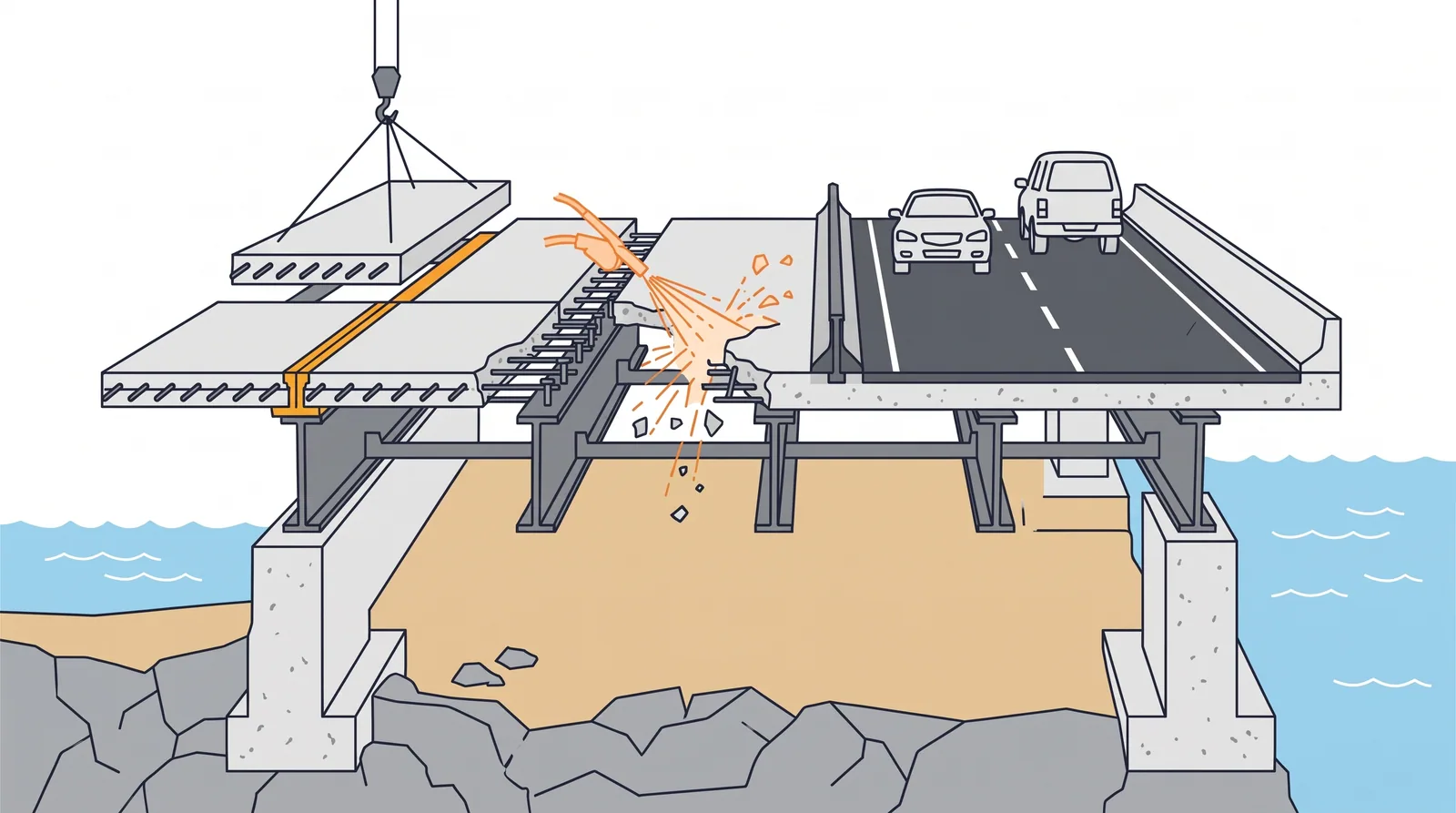
- Remove the old slab by saw-cutting into panels and lifting out, or by hydrodemolition around the girder flanges to keep the steel and connectors; protect the area below with a debris shield.
- Repair girder tops, install new shear connectors, and set formwork or full-depth precast panels on levelling bolts with the haunch matched to the girder camber.
- Cast-in-place: fix reinforcement and pour with a finishing machine set to the deck profile, then wet cure for 7 days. Precast: grout shear pockets and haunches, apply longitudinal post-tensioning where detailed, and grind or overlay for ride.
- Widening: build new foundations and piers or extend the caps, erect new girders matched to the old in stiffness and camber, and cast the new slab, leaving a closure strip to the old deck until most of the new dead-load deflection has taken place.
- Cast the closure strip with traffic vibration managed (speed restriction, lane closure or retarded concrete), lap or couple the transverse bars, then complete barriers, joints, waterproofing and surfacing.
- Switch traffic and repeat for the next stage; record girder repairs, panel positions and camber as built.
Key numbers
- Full-depth precast panels200–250 mm thick, typically 2.4–3.6 m along the bridge, with grouted shear pockets at about 0.6–1.2 m centres
- Hydrodemolitionwater jets at about 100–250 MPa remove concrete without damaging bars or girders
- Staged cast-in-place redeckingabout a span per month per stage; precast panels a span in about a week of night closures
- Widening closure stripcommonly 0.6–1.5 m wide, cast after the new girders have taken their dead-load deflection
- Indicative costUSD 400–900 per m² of deck replaced
Where it fits
- Decks past 40-60 years in de-icing climates, bridges needing more lanes, girders still sound.
Where it does not
- Redecking girders with unknown condition; widening on piers that cannot take the extra load without strengthening.
Choosing it
- Choose an overlay or patching over replacement while deterioration is local and chloride at bar level is below the corrosion threshold over most of the deck, and the girders and connectors are sound.
- Choose full-depth precast panels over cast-in-place when traffic can be released only at night or weekends; accept a higher unit cost and the need for careful haunch and camber control.
- Choose superstructure replacement (new girders and deck, often prefabricated and moved in) when the girders are fatigue-prone, under-strength, or the new width or clearance needs a different structure.
- For widening, tie the new deck to the old when foundations will behave alike and one continuous surface matters; build a separate parallel structure with a longitudinal joint when settlement or stiffness will differ or the old substructure cannot take more load.
Plant, pace and money
Risks and controls
What goes wrong
- Girder damage during demolition, traffic loading on a half deck, differential settlement between old and new.
Quality assurance
Girder inspection after demolition, connector installation records, camber matching.
Origins
Staged redecking under traffic became routine in North America and Europe from the 1970s as de-icing salt destroyed decks built in the 1950s and 1960s. The Golden Gate Bridge redecking (1982–86) showed that night-time panel replacement works on a major suspension bridge, and full-depth precast panel systems later became standard for accelerated redecking.
Examples
US interstate redecking programmes; Korean expressway widening from four to six lanes.
Case studies
Related methods
Further reading
FHWA Bridge Preservation Guide · PCI full-depth panel guidelines · NCHRP Report 584 Full-depth precast concrete bridge deck panel systems · FHWA Accelerated Bridge Construction Manual