How bridges get built · Finishing, articulation and maintenance · Bridge demolition and deconstruction
Also called: bridge removal, deconstruction, controlled demolition, reverse launching
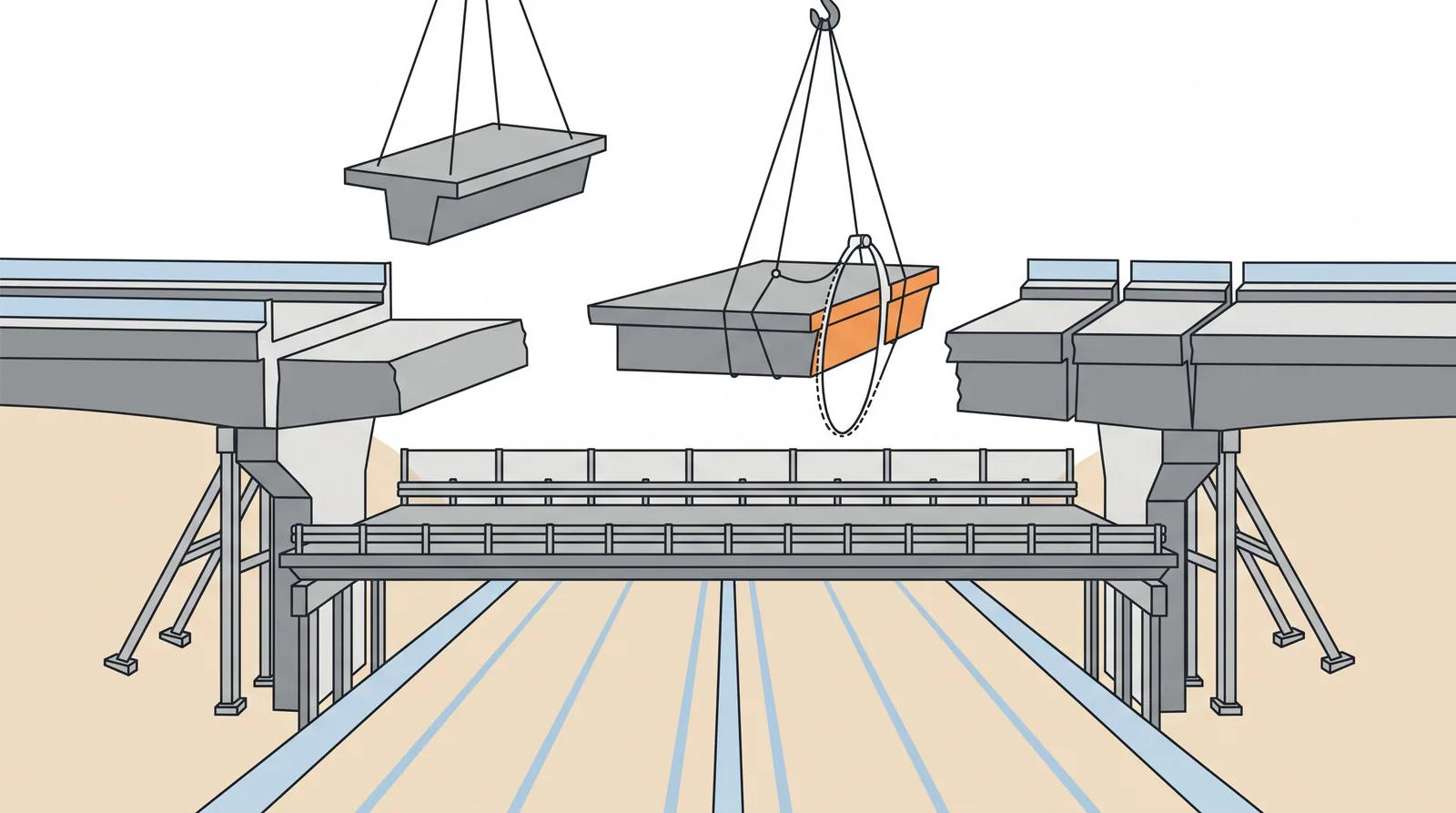
How it is done
- Investigate: original drawings and records, actual condition (cores, tendon inspection windows, NDT), hazardous materials (asbestos, lead paint, PCBs, contaminated sediment), services on and under the bridge, and what lies below.
- Choose the method: saw-cut and lift, reverse erection (cantilever, launching, strand-jack lowering), SPMT removal of whole spans, mechanical breaking from the ground, or explosive felling where an exclusion zone can be held.
- Engineer every stage as for erection: stability of the partly removed structure, release of prestress and stored energy, temporary supports, crane and SPMT loads on the remaining structure and ground, and the order of cuts.
- Protect what is below with crash decks, catch platforms or sand beds over roads and tracks, debris netting, and turbidity curtains in water; agree possessions and navigation closures.
- Strip services, surfacing, parapets and other non-structural items first, then cut and remove the deck in the planned sequence, monitoring movement and crack opening at critical cuts.
- Locate and de-tension or encapsulate post-tensioning tendons before cutting, or cut only where they are known to be inactive; treat cantilevers and hinges as able to fail suddenly.
- Demolish piers and abutments, cut piles below bed or ground level as permitted, recycle crushed concrete and steel, and restore the site; record what was found for owners of similar bridges.
Key numbers
- Diamond wire sawing of reinforced concretetypically 1–3 m² of cut face per hour
- Lifted piecescommonly 20–200 t, set by crane radius and transport
- SPMT removalwhole spans of several hundred to a few thousand tonnes in a single closure
- Recyclingconcrete and steel, usually well over 90 % of the mass, can be recycled
- Indicative costUSD 150–400 per m² of deck removed, more over rail, roads and water
Where it fits
- Every replacement project; the game's lateral slide and SPMT sites include removal of the old bridge.
Where it does not
- Cutting post-tensioned members without knowing the tendon state; dropping spans onto navigation routes or live tracks.
Choosing it
- Choose saw-cut and lift over mechanical breaking where the bridge spans live traffic, rail or water and nothing may fall; it is slower and needs large cranes but controls every piece.
- Choose SPMT removal or slide-out of whole spans when a short full closure is available and there is a laydown area to break the span up off line.
- Choose explosive felling only where a wide exclusion zone can be cleared and the debris can land on ground or water that can be cleaned up; it is fastest but needs the most planning and consent.
- Prefer reversing the original erection method for segmental, cable-stayed and launched decks; the structure was designed for those stages.
Plant, pace and money
PlantSaws, breakers, cranes, crash decks, barges, hydro-demolition.
ProductivityA span per week for controlled removal.
CostUSD 150-400 per m2 of deck removed, more over rail and water.
Risks and controls
What goes wrong
- Uncontrolled collapse during cutting (several fatal accidents), falling debris, environmental release.
Quality assurance
Demolition engineering with stage checks, exclusion zones, monitoring during cuts.
Origins
Bridge demolition became an engineering discipline of its own as the motorway bridges of the 1950s–70s reached the end of their lives; accidents during removal, and the finding that post-tensioned decks store energy and hide corrosion, led to codified planning such as BS 6187 and to the rule that removal be designed with the same rigour as erection.
Examples
Old Tappan Zee (2017-2019), Hong Kong flyover removals over live roads, Korean overpass replacements in weekend possessions.
Case studies
Lake Champlain BridgeUSA · 2009The 1929 bridge was closed in October 2009 after inspection found severe deterioration of its piers and was felled with explosives in December 2009; the replacement opened in 2011.
Tappan Zee BridgeUSA · 2017–19Approach and truss spans were removed by floating crane and barge; the last steel truss span was felled into the Hudson with explosives in January 2019 and lifted out.
Polcevera Viaduct (Morandi bridge) remainsItaly · 2019Deck sections were cut and lowered with strand jacks, and the eastern piers were demolished with explosives in June 2019 in a dense urban area.
Related methods
Lateral slide (slide-in bridge construction)SPMT move (self-propelled modular transporters)Deck replacement and wideningWorking over live railways: possessions and blockades
Further reading
NDA Demolition Guidelines · BS 6187 Code of practice for full and partial demolition