How bridges get built · Piers, pylons and abutments · Climbing and jump formwork
Also called: jump form, self-climbing formwork, crane-climbing formwork
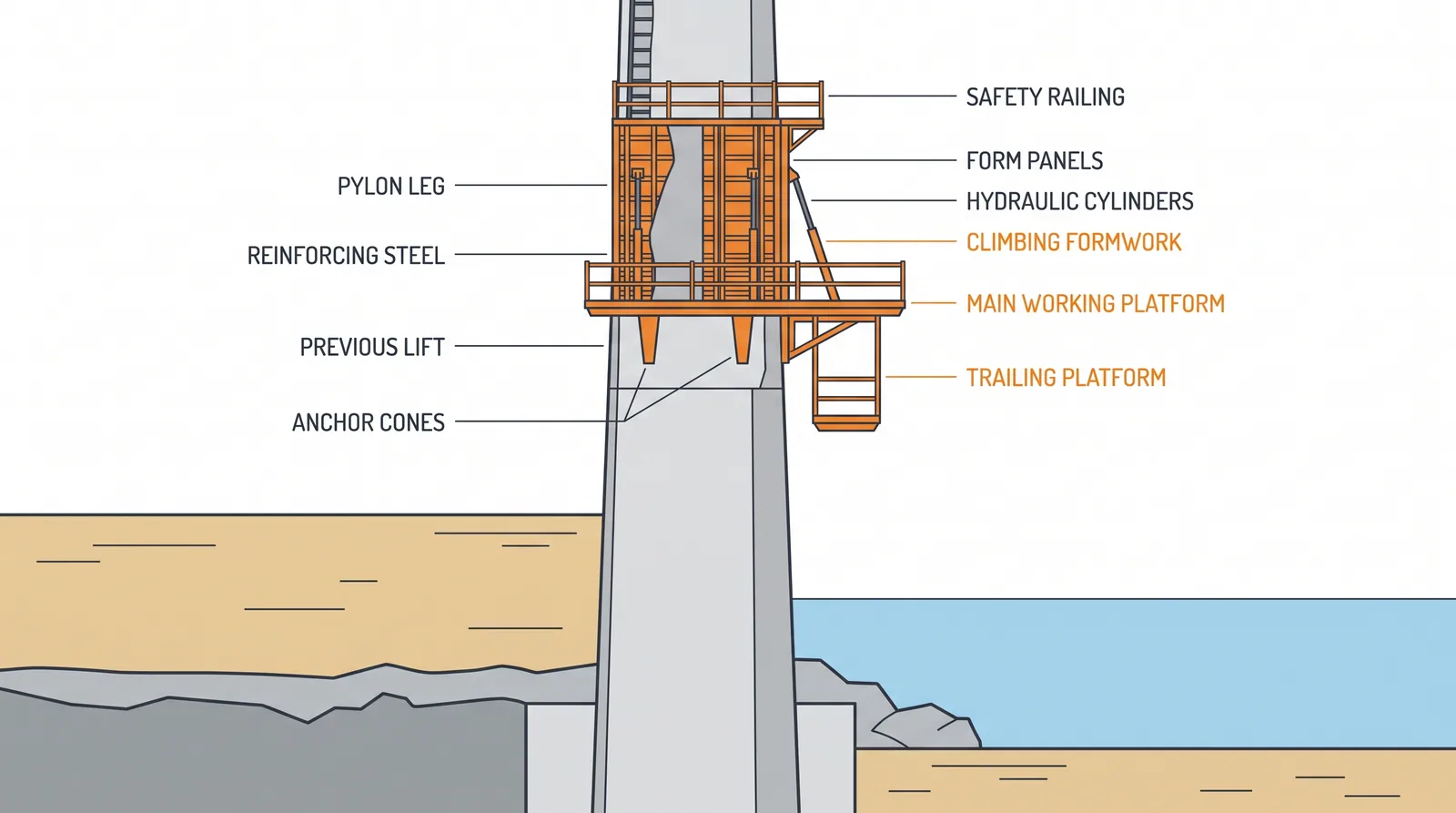
How it is done
- Cast the first one or two lifts conventionally and set the climbing anchors (cast-in cones or bolts) in the last lift at the bracket positions on the climbing drawings.
- Mount the brackets or rails on the anchors and build the platforms: reinforcement deck above, main working deck at form level, and a trailing finishing platform below for anchor recovery and patching.
- Cycle: fix reinforcement and embeds (prefabricated cages where possible), set the next anchors, close and plumb the forms, pour the 4–5 m lift and strip.
- Climb only when the concrete at the new anchors has reached the supplier's minimum strength: crane-climbing units are lifted as complete units, self-climbing units jack their rails and brackets up on hydraulic cylinders without the crane.
- Adjust the panels for taper, wall-thickness changes and inclination; inclined pylon legs need temporary struts or ties until the cross beam is built.
- Survey every lift for position, verticality and twist at a fixed time of day (early morning) with temperature correction, and correct drift gradually over several lifts.
- Observe hold points before each climb (anchor record, platforms cleared of stored material, wind below the climbing limit); at the top, dismantle by crane and make good the anchor holes.
Key numbers
- Lift height3–6 m, most often 4–5 m
- Cycle3–5 days per lift on plain shafts, 5–8 days in congested pylon anchorage zones
- Economic above about 25–30 m height
- Concrete strength at the anchors before climbing: typically about 10–20 MPa, as the supplier specifies
- Verticalityabout 1/1,000 of the height for piers, with tighter targets on tall pylons
Where it fits
- Piers over 25 m, valley viaducts, concrete pylons of 60-300 m, inclined pylon legs (with tie-backs during construction).
Where it does not
- Short piers, where the setup costs more than it saves.
Choosing it
- Choose climbing over slipform when the section changes, embeds and anchorages are dense, lift joints are acceptable, or the site cannot run continuously 24 hours a day.
- Choose self-climbing over crane-climbing when the crane is the bottleneck (several legs, tall pylons) or wind often stops crane lifts of large units.
- Prefer conventional lifts below about 25 m height or for a handful of piers.
- Prefer slipform for tall, constant-section shafts with a crew and concrete supply able to run without stops.
Plant, pace and money
PlantClimbing system (Doka, Peri or similar), tower crane or self-climbing hydraulics, concrete pump with placing boom.
ProductivityOne 4-5 m lift per 4-7 days per leg; a 150 m pylon in 8-12 months.
CostUSD 600-1,200 per m3 of pylon concrete including the system.
Risks and controls
What goes wrong
- Anchor failure during climbing, wind on platforms, geometry drift accumulating over the height, cable anchorage zones with congested reinforcement.
Quality assurance
Survey of every lift (verticality within height/1,000 or better), anchor cone tests, reinforcement cover checks, temperature control in thick sections.
Origins
Climbing forms grew out of shaft, chimney and dam construction; crane-climbed bracket systems were common on tall bridge piers by the 1960s and 1970s, and hydraulic self-climbing systems became normal on tall piers and pylons from the 1990s.
Examples
Millau (245 m piers), Sutong and Russky pylons, Incheon Bridge pylons; the game's pylon duration is based on lift cycles.
Case studies
Millau ViaductFrance · 2004Concrete piers up to 245 m (pier P2) climbed in lifts of about 4 m; each pier splits into two thinner shafts for its top 90 m.
Russky Bridge, VladivostokRussia · 2012A-shaped concrete pylons 320.9 m high, climbed lift by lift in a harsh winter climate for a 1,104 m cable-stayed span.
Willow Island cooling towerUSA · 1978Not a bridge, but the defining climbing-form accident: 51 workers died when the climbing scaffold fell because the concrete holding its anchors was too young.
Related methods
Cast-in-place piers with formwork liftsSlipformPylon construction: concrete, anchorage zones and geometrySteel and composite pylons
Further reading
fib Bulletin 48 (formwork) · manufacturer engineering guides