Also called: proof load test, acceptance test, as-built documentation, bridge handover
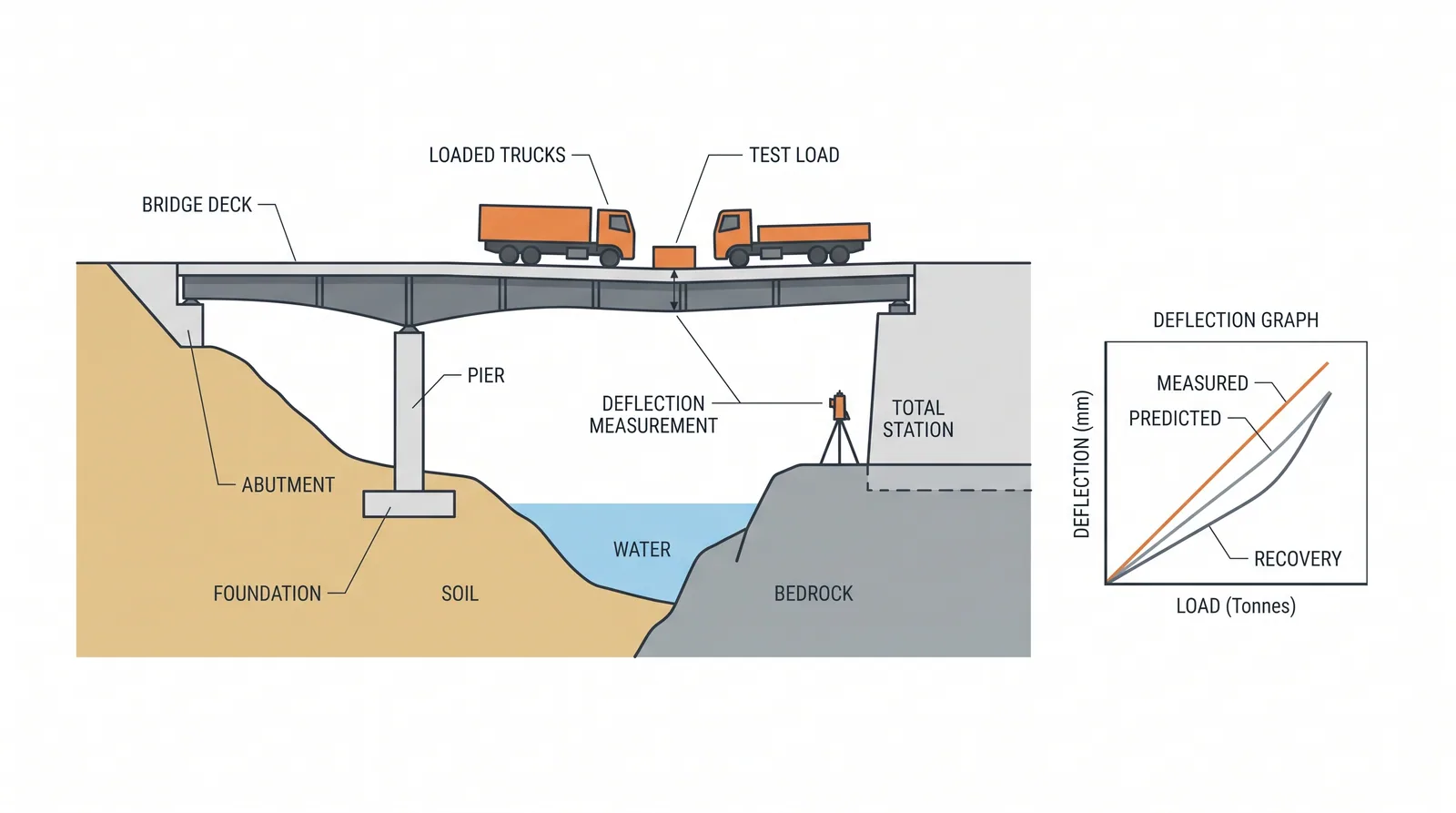
How it is done
- Plan the test with the designer and the checker: purpose (acceptance, proof or diagnostic), load cases, truck positions, target effects, predicted responses with tolerances, and stop criteria.
- Weigh every truck axle by axle on a certified weighbridge and mark the truck positions on the deck from a survey grid.
- Instrument the bridge: precise levelling or total stations, displacement transducers, strain gauges, tiltmeters, temperature sensors and accelerometers; take zero readings and record temperature drift before loading.
- Load in increments, holding each stage until readings stabilise and comparing each reading with the prediction; stop if a limit is exceeded.
- Unload and measure recovery; accept when measured responses lie within the expected range and the residual deflection is small.
- Run the dynamic test: trucks at several speeds and over a plank, or ambient vibration, to measure natural frequencies, mode shapes and damping for comparison with the model.
- Complete the principal inspection and the as-built file (drawings, bearing and joint pre-set records, PT and cable force records, material certificates, test report, inspection and maintenance manual, baseline monitoring readings) and hand over with a list of open items.
Key numbers
- Target load effectcommonly 60–90 % of the design live-load effect in the governing sections
- Test trucks30–45 t each; from a handful on short spans to 50 or more on long viaducts
- Hold time per stageuntil readings stabilise, usually 10–30 minutes
- Residual deflection after unloadingcommonly required below about 10–20 % of the peak
- Measured deflections usually fall below prediction (concrete stiffer than assumed, parapets contributing); a response above prediction is a trigger to stop and investigate
- Durationone to three days of testing per bridge; weeks of documentation
Where it fits
- All new bridges in many jurisdictions (mandatory in Italy, Spain, Poland, Korea for large bridges); recommended for long spans and unusual structures.
Where it does not
- Testing without an analysis to compare against; overloading.
Choosing it
- Choose a full static and dynamic acceptance test where the code requires it, for long spans and cable-supported or unusual structures, or where the construction record raises doubts; it also calibrates the model used for lifelong monitoring.
- Prefer a diagnostic test (moderate loads, many instruments) to rate an existing bridge whose behaviour is uncertain; use a proof test only when analysis cannot give a credible rating and the risk of damage is accepted.
- Prefer ambient vibration testing when traffic cannot be stopped; it gives frequencies and mode shapes but no direct check of load paths.
Plant, pace and money
Risks and controls
What goes wrong
- Unexpected deflection revealing a construction error; damage from overloading.
Quality assurance
Independent review of test results; complete document set as a condition of handover.
Origins
Proof loading of new bridges dates from the iron railway bridges of the 19th century. Italy (collaudo), Spain and several other countries kept the acceptance load test as a statutory step for new bridges, while North American practice uses load testing mainly to rate existing bridges (AASHTO Manual for Bridge Evaluation).
Examples
Every game bridge finishes with the load test segment; Korean special bridges undergo static and dynamic tests before opening.
Case studies
Related methods
Further reading
Korean bridge load testing standards · Italian CNR guidelines · AASHTO Manual for Bridge Evaluation Chapter 8 · NCHRP Research Results Digest 234 Manual for bridge rating through load testing · ACI 437.2 Code requirements for load testing of existing concrete structures · Spanish Ministry of Public Works, Recommendations for load testing of road bridges (1999)