How bridges get built · Cast-in-place concrete decks · Falsework on temporary piles (shallow water)
Also called: piled falsework, trestle falsework, falsework in water
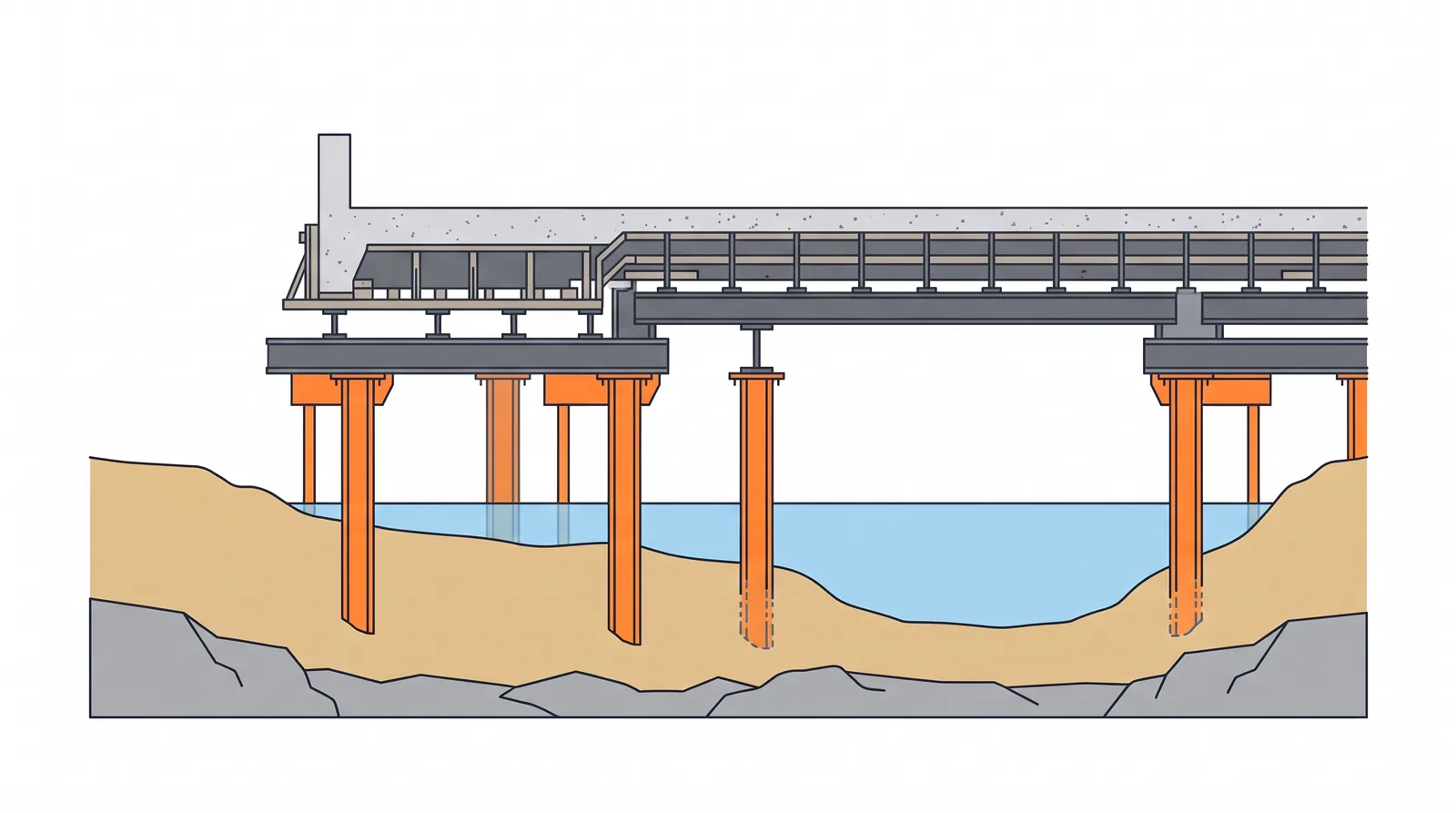
How it is done
- Collect the hydrology for the construction window (water levels, velocities, flood season, debris, ice, navigation) and design the falsework for current, debris and boat impact as well as the pour.
- Drive temporary steel pipe or H-piles in bents from a barge, or pitch and drive from the previous bent, usually with a vibratory hammer; record penetrations and check capacity.
- Brace each bent at low water, cap it with head beams and span between bents with steel beams or trusses; build the soffit as for ground falsework, including pile shortening and beam deflection in the casting levels.
- Protect the bents against scour and debris with rock, deflectors or booms, and monitor bed levels around the piles.
- Pour the deck in the planned sequence with settlement monitoring, and keep a flood watch with trigger levels for stopping work and evacuating.
- After stressing and striking, remove the beams and extract the piles with the vibratory hammer before the flood season, or cut them below bed level where allowed.
Key numbers
- Water depthup to about 3–5 m; current preferably under about 1.5–2 m/s
- Bent spacingcommonly 6–12 m with steel beams, more with trusses
- Temporary pilessteel pipe or H-piles embedded below the predicted scour depth
- Cycle45–60 days per span
- Premium over ground falseworkabout USD 100–250 per m2 of deck
Where it fits
- Slow rivers and canals up to about 3 m deep, spans 20-45 m, dry-season programmes.
Where it does not
- Water beyond 3-5 m, velocities over 2 m/s, navigable routes, flood seasons.
Choosing it
- Choose piled falsework over a trestle with crane-erected precast girders when the deck must be cast in place (curved, variable or continuous) and the water is shallow and slow.
- Prefer an MSS, launching girder or incremental launching when there are many spans, the flood season falls inside the programme, or navigation must stay open.
- Prefer balanced cantilever when the water is deeper than about 5 m or the current is fast.
Plant, pace and money
PlantPiling rig or barge with vibro-hammer, temporary piles, falsework, formwork.
ProductivitySlower than ground falsework: allow 45-60 days per span.
CostAdds USD 100-250 per m2 for the piles and bracing.
Risks and controls
What goes wrong
- Flood taking the falsework, debris loading, scour of the temporary piles, boat impact.
Quality assurance
Flood watch and evacuation plan, pile driving records, bracing inspection.
Origins
Piled staging in rivers is as old as timber centering; steel H and pipe piles installed and recovered with vibratory hammers made it routine and reusable from the 1960s.
Examples
Small river bridges in Korea, Japan and Europe until the 1980s; still used for canals and irrigation crossings.
In the bridge game
What Bridge Master applies when you pick it
Deck types: RC slab, Voided slab, RC T-beam, RC box, PSC box (cast in place), Rigid frame, Concrete arch, PSC box, balanced cantilever, Extradosed, Network tied arch. Spans 20-45 m, up to 60 m.
- +25: Shallow, slow water: piled falsework is the cheap answer.
- -40: Too deep for piled falsework.
- -30: Fast water loads the temporary piles and debris piles up.
- -15: Only in the dry season; the falsework must be out before the floods.
- -30: Blocks the navigation route.
- not allowed: Piled falsework in 5 m+ of water is not a temporary works design, it is a bridge.
- not allowed: Temporary piles in the water where in-water works are banned.
- not allowed: Piled falsework is for spans over shallow water; on dry ground use ground falsework.
Related methods
Full staging method (ground falsework)Temporary trestles and access bridgesLaunching girder (beam launcher) for precast girders
Further reading
BS 5975 · Japan Road Association temporary works