How bridges get built · Finishing, articulation and maintenance · Surfacing: asphalt, SMA, concrete and thin overlays
Also called: bridge pavement, asphalt on bridges, epoxy asphalt, Gussasphalt, polymer overlay
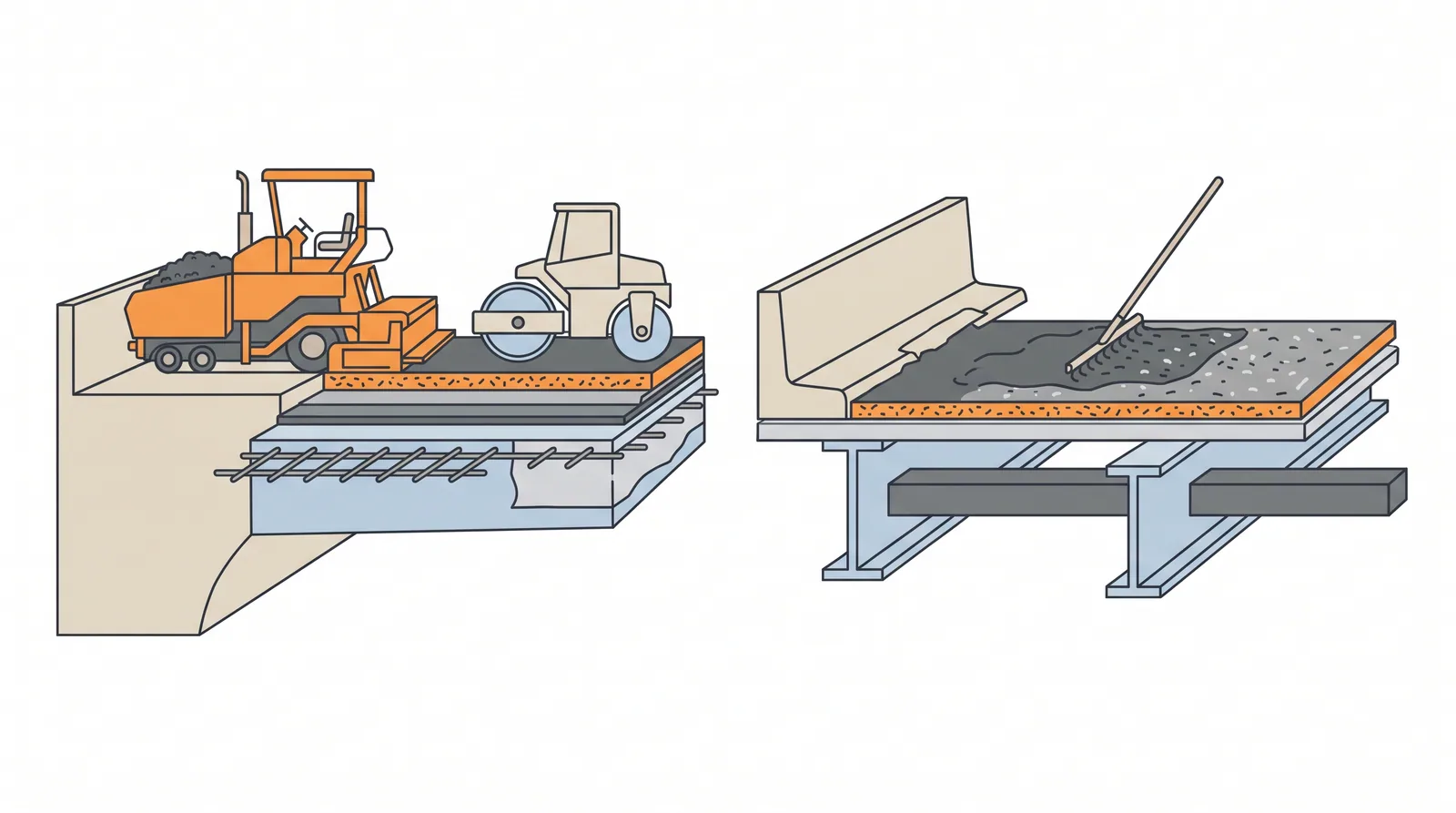
How it is done
- Confirm the build-up with the deck designer: total thickness and dead load allowed, membrane and protection layer, bond requirements, crossfall, and levels at joints and drains.
- Concrete decks: apply a tack coat over the membrane protection, then lay a binder course and a wearing course of dense asphalt or SMA in two lifts of 40–70 mm compacted.
- Compact with static or oscillating rollers rather than full vibration on thin decks and near joints; hand-work around gullies and joint nosings, and do not overheat the membrane.
- Orthotropic steel decks: blast the plate to Sa 2½, prime, apply the bonding and waterproofing layer, then pour Gussasphalt hot (about 220–250 °C) or place epoxy asphalt within its timed working window; total 50–80 mm in one or two layers.
- Control plate and air temperature, moisture and layer bond: blisters form when water or solvent is trapped, and epoxy asphalt needs a dry plate and a defined cure (typically a day or two) before traffic.
- Thin polymer overlays: shot-blast the deck, apply epoxy or polyester binder and broadcast calcined bauxite or basalt aggregate to refusal in two layers (6–10 mm total); open to traffic after a few hours.
- Test bond, thickness and texture, survey ride and levels across joints, and record the build-up and its weight for future load rating.
Key numbers
- Asphalt on concrete decks80–100 mm total in two layers, about 2.0–2.4 kN/m²
- Orthotropic steel decks50–80 mm (epoxy asphalt about 50–60 mm; Gussasphalt systems 70–80 mm)
- Thin polymer overlays6–10 mm, about 0.15–0.25 kN/m²
- Gussasphalt laying temperatureabout 220–250 °C
- Service lifeSMA wearing course 10–20 years; epoxy asphalt 20–40 years on a well-built deck; polymer overlays 10–25 years
- Indicative costasphalt USD 25–45 per m²; epoxy asphalt USD 80–150 per m²
Where it fits
- All bridges; SMA for heavy traffic, epoxy asphalt for steel decks in hot climates, thin overlays for weight-critical and movable bridges.
Where it does not
- Thick asphalt on long-span steel decks (weight), plain asphalt on orthotropic plates in the Gulf (rutting and debonding).
Choosing it
- Choose SMA over dense asphalt concrete for heavy traffic and hot climates: better rut resistance and lower permeability.
- Choose epoxy asphalt over Gussasphalt on orthotropic decks in hot climates or with heavy, slow trucks: stiffer and more rut-resistant, but it needs specialist mixing, a strict cure window and is hard to patch.
- Choose a thin polymer overlay over asphalt where dead load must be minimal (movable and long-span steel decks) or as a preservation treatment on a sound concrete deck; avoid it on cracked or chloride-loaded decks.
- Choose a bare textured concrete deck where the deck itself is the wearing surface (low-permeability concrete with extra cover); asphalt over an unwaterproofed deck traps salt water.
Plant, pace and money
PlantPavers, rollers, Gussasphalt cookers, overlay rigs.
ProductivityA deck in days.
CostAsphalt USD 25-45 per m2; epoxy asphalt USD 80-150 per m2; the game's pavement options carry these differences.
Risks and controls
What goes wrong
- Debonding on steel, rutting, reflective cracking at joints.
Quality assurance
Bond tests, thickness cores, ride quality survey.
Origins
Mastic asphalt (Gussasphalt) has surfaced German orthotropic decks since they were introduced in the 1950s. Epoxy asphalt entered bridge service on the orthotropic deck of the San Mateo–Hayward Bridge in 1967 and became the usual choice for long-span steel decks in the United States and China.
Examples
Epoxy asphalt on Chinese and Gulf steel decks; Gussasphalt on German and Japanese decks.
Case studies
San Mateo–Hayward BridgeUSA · 196757 mm of epoxy asphalt placed in two lifts on the orthotropic deck lasted more than 30 years without cracking or debonding; it was replaced with polyester polymer concrete in 2015.
Fremont Bridge, PortlandUSA · 1973 (resurfaced 2011)Original epoxy asphalt on the orthotropic deck of the tied arch was replaced with new epoxy asphalt after about 38 years.
San Francisco–Oakland Bay Bridge, self-anchored suspension spanUSA · 2013Epoxy asphalt on the orthotropic deck, with a specified 48 h cure after placement and a surface treatment for skid resistance.
Related methods
Deck waterproofing and drainageOrthotropic steel decksBonded deck overlays: latex-modified, silica fume, UHPC and polymer
Further reading
FHWA orthotropic deck manual (surfacing chapter) · Asphalt Institute guidance · ZTV-ING Part 7 Bridge deck surfacing (Germany) · ISO 8501-1 Preparation of steel substrates