Also called: bridge deck membrane, waterproofing, deck drainage
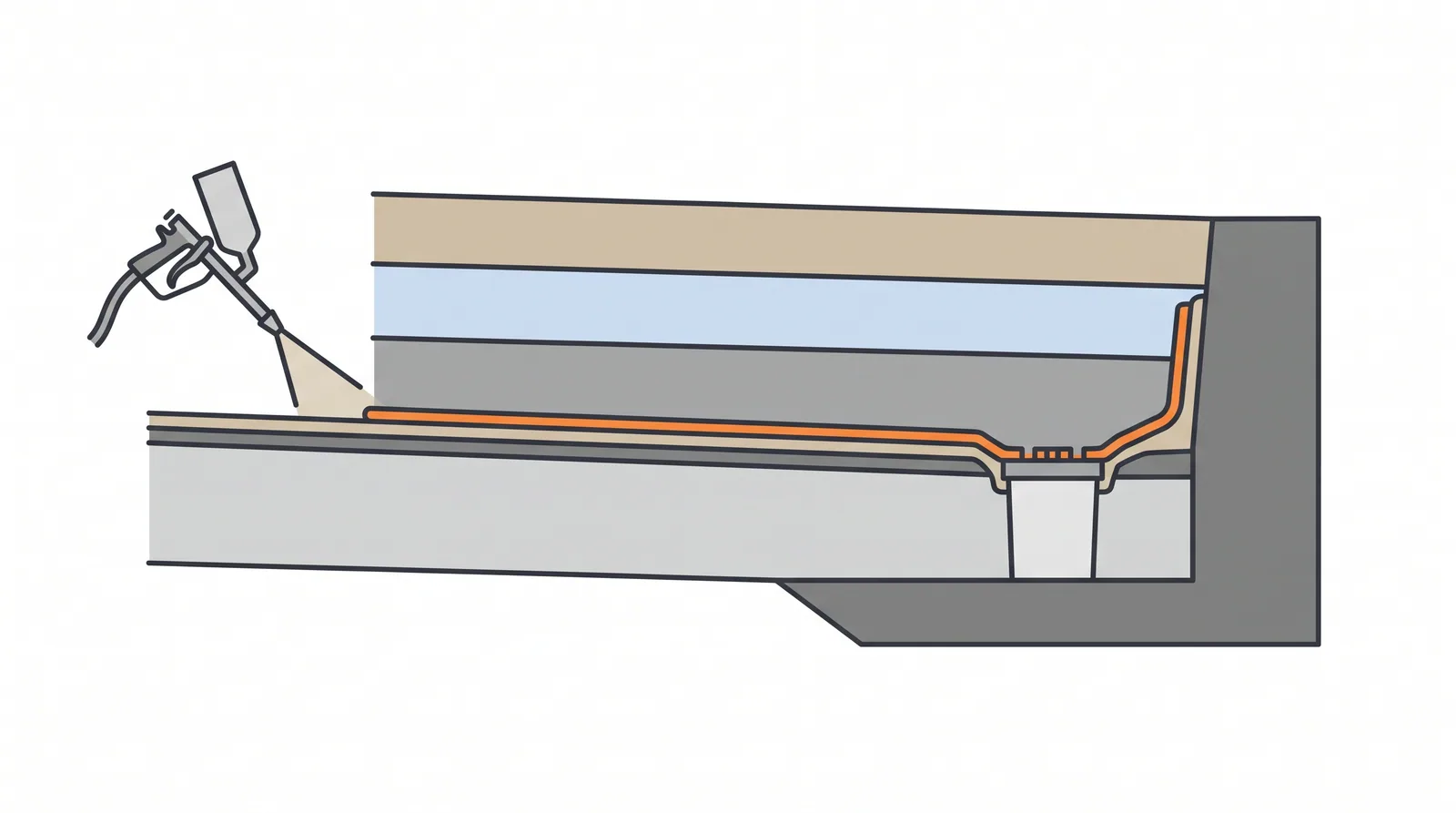
How it is done
- Fix the system at design stage: membrane type, protection layer, falls, gully positions, upstands at kerbs and joints, and drip details; check that crossfall and longitudinal fall carry water to the outlets without ponding.
- Prepare the deck once the concrete is old enough for the system: remove laitance and curing compound by shot or grit blasting, fill blowholes, and confirm surface moisture and that the deck is above the dew point.
- Prime and apply the membrane: sprayed methyl methacrylate or polyurethane in two coats of contrasting colour, or bitumen sheets with lapped and sealed joints; turn it up at kerbs and into joints and drain outlets.
- Test before covering: film thickness, spark (holiday) testing of sprayed systems, adhesion pull-off tests and inspection of laps; repair defects.
- Place the protection layer or first asphalt course at controlled temperature, keeping tracked plant and sharp aggregate off the bare membrane.
- Install gullies at low points and on the upstream side of joints, edge drains to remove water trapped on the membrane, and carrier pipes discharging away from piers, bearings and the ground below.
- Flow test the drainage, record membrane areas and batches, and put gully cleaning into the maintenance manual.
Key numbers
- Sprayed membranes (MMA, polyurethane)about 2–3 mm dry in two coats; MMA cures in about an hour
- Bitumen sheet membranesabout 4–5 mm, laps of 100–150 mm
- Deck fallscrossfall typically 2–2.5 %; avoid longitudinal grades below about 0.5 %
- Outputabout 1,000–3,000 m² per day for sprayed systems
- Indicative costUSD 30–70 per m² installed
Where it fits
- All concrete decks with asphalt surfacing; steel decks under polymer overlays have their own systems.
Where it does not
- Membranes applied to damp or dusty decks; drains that discharge onto the pier.
Choosing it
- Choose a sprayed membrane over sheets on complex geometry, around many upstands, or where a fast cure matters; choose sheets where the crew and climate suit torch-on work and the deck surface is rough.
- Choose a membrane under asphalt over a bare deck wherever de-icing salt or marine chloride is present; asphalt without a membrane traps salt water against the concrete and is worse than no surfacing.
- Prefer a bonded concrete or polymer overlay to a membrane where the deck must carry traffic directly without asphalt, or where an existing bare deck is being preserved.
Plant, pace and money
Risks and controls
What goes wrong
- Blistering, pinholes, damage from paving plant, blocked drains.
Quality assurance
Adhesion and thickness tests, holiday testing, drainage flow test.
Origins
European concrete decks have been waterproofed under asphalt since the mid-20th century, first with mastic asphalt and bitumen sheets, later with sprayed MMA and polyurethane systems; the UK made certified membranes a requirement for trunk road bridges (BD 47, now CD 358). Much of North America instead kept bare decks and relied on concrete quality, cover, sealers and, from the 1970s, epoxy-coated reinforcement.
Examples
Standard on Korean, European and Gulf decks; US decks often use bare concrete with sealers instead.
Case studies
Related methods
Further reading
BD 47 / CD 358 (UK) · AASHTO M 333 · NCHRP Synthesis 425 Waterproofing membranes for concrete bridge decks · EN 14695 Reinforced bitumen sheets for waterproofing of concrete bridge decks · ETAG 033 Liquid-applied bridge deck waterproofing kits