Also called: PT, internal tendons, external tendons, grouting of ducts
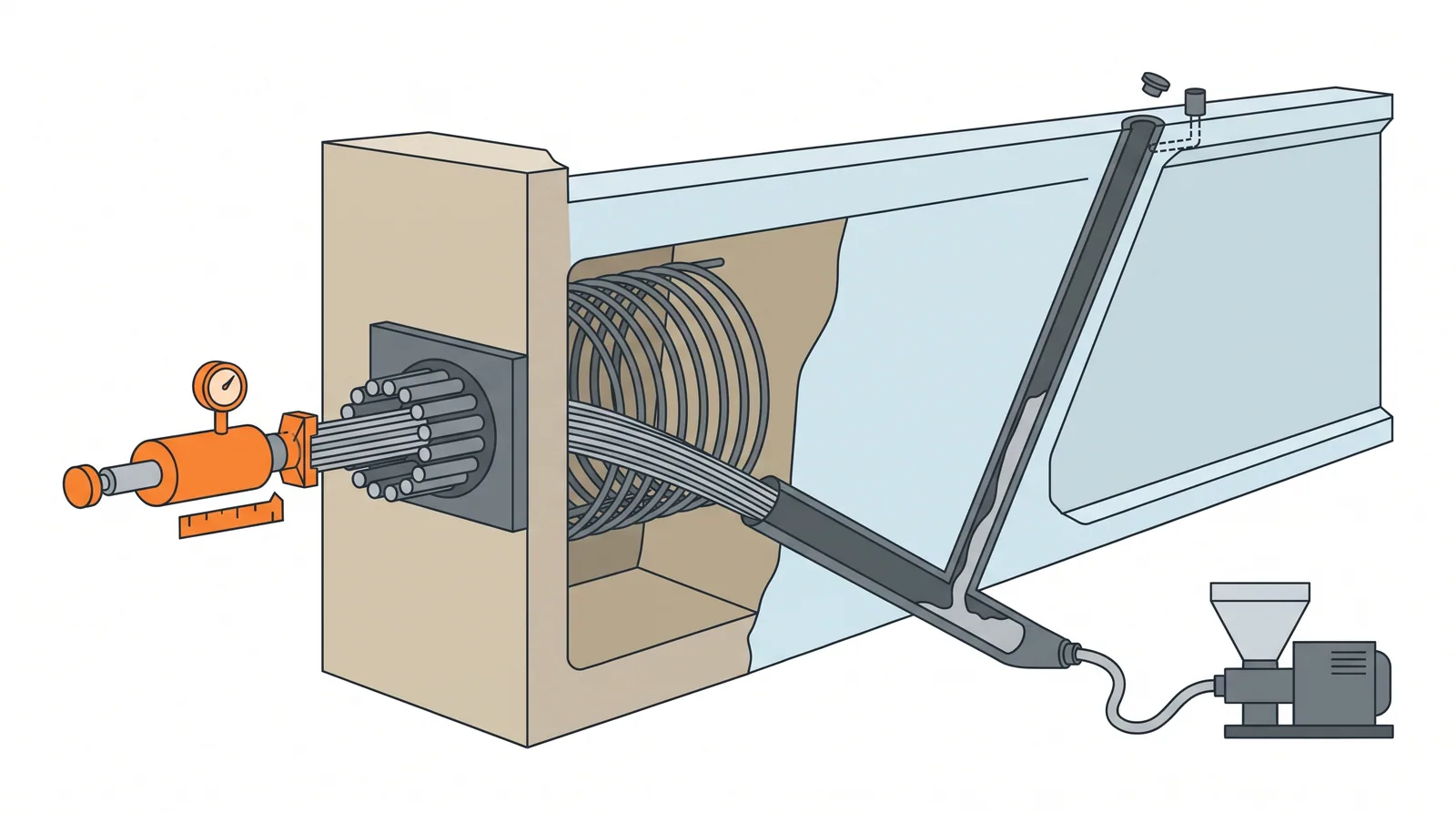
How it is done
- Install the ducts (corrugated plastic for enhanced protection, or steel) to the profile on supports at about 0.6–1.0 m, with sealed couplers, vents at high points, drains at low points and anchorages fixed to the forms.
- Pressure-test the duct system before concreting where specified, and keep the ducts clear during the pour with mandrels or swabbing.
- Thread the strands, pushed or pulled, once the concrete has reached stressing strength, and fit the anchor heads and wedges.
- Stress with calibrated jacks in the specified sequence, recording force, elongation and wedge draw-in; investigate any tendon outside the elongation tolerance before cutting the tails.
- Grout promptly with a prebagged, low-bleed thixotropic grout, pumping from the low point until clean grout flows from each vent in turn, then hold pressure and close.
- Inspect after grouting (vent probing or endoscope), fill any voids by vacuum grouting, and protect the anchorages with caps and sealed pour-backs.
- Hand over the stressing and grouting records; for external tendons meant to be replaceable, use flexible fillers (wax or grease) or detail them for removal.
Key numbers
- Strand15.2 mm (0.6 in) seven-wire, fpu 1,860 MPa, area 140 mm2
- Tendonscommonly 7–31 strands
- Jackingup to about 0.80 fpu; wedge draw-in about 6 mm
- Elongationwithin about ±5–7 % of the calculated value
- Duct friction coefficientabout 0.15–0.25
- Groutingcommonly within 7 days of stressing
- CostUSD 6–12 per kg of installed tendon
Where it fits
- All post-tensioned decks, pier caps, pylon anchorage zones, transverse deck PT.
Where it does not
- Grouting in freezing weather, grout with chloride or excessive bleed, leaving ducts ungrouted for weeks.
Choosing it
- Choose internal bonded tendons for crack control and ultimate capacity in most decks; choose external tendons when inspection, monitoring and replacement matter, as in segmental boxes.
- Prefer flexible fillers (wax or grease) over cement grout for external tendons that must stay replaceable, at higher cost.
- Choose bars over strands for short, straight tendons (anchorage zones, temporary PT, pier caps).
Plant, pace and money
Risks and controls
What goes wrong
- Grout voids (the Ynys-y-Gwas and Florida failures), strand corrosion at anchorages, duct damage during concreting, strand slip at stressing.
Quality assurance
Stressing records for every tendon, grout tests (fluidity, bleed, strength), vent inspection, anchorage sealing inspection; modern practice adds duct pressure tests before grouting.
Origins
Freyssinet patented prestressing in 1928 and introduced his wedge anchorage and double-acting jack in the late 1930s; after grout failures such as Ynys-y-Gwas (1985), the UK suspended new grouted post-tensioned bridges from 1992 to 1996, and today's practice of plastic ducts, prebagged grouts and pressure testing grew out of that period.
Examples
All the game's PSC decks assume proper PT; the upkeep score penalises nothing here only because the game cannot see grout.
Case studies
Related methods
Further reading
PTI/ASBI M50 Specification for Grouting · fib Bulletin 20 · EN 445-447 · Concrete Society TR72, Durable post-tensioned concrete structures · fib Bulletin 33, Durability of post-tensioning tendons