How bridges get built · Piers, pylons and abutments · Pier protection: fenders, dolphins and collision walls
Also called: ship impact protection, fender system, dolphin, crash wall
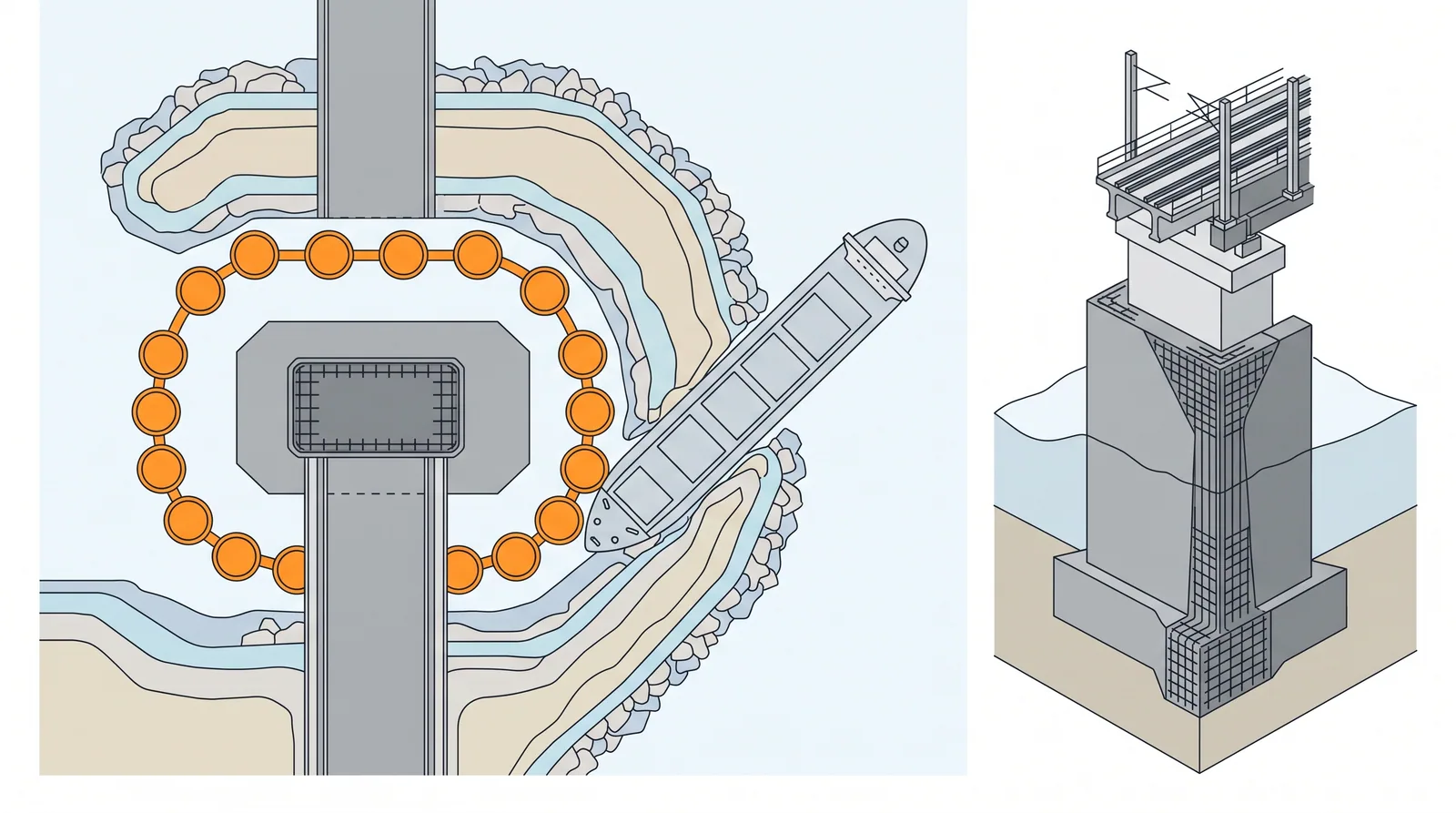
How it is done
- Define the waterway and the design vessel fleet now and over the bridge life, with speeds, currents and the acceptance criterion (AASHTO annual frequency of collapse).
- Run the vessel-collision risk analysis: probability of aberrancy, geometric probability of hitting each pier, impact energy and the pier's resistance.
- Choose the defence: strengthen the pier, place dolphins (rock-filled sheet-pile cells or pile clusters), build protective islands, fit energy-absorbing fenders, or move piers out of reach with a longer span.
- Build from barges: install piles or cells, fill and cap them and place rock armour on filter layers; check the protection for scour and for its effect on currents and navigation.
- Fit navigation aids: pier and span lights, channel marks and, where justified, vessel monitoring and bridge-warning systems.
- Beside railways, set piers back, design them for derailment loads, or build crash walls to AREMA or EN 1991-1-7 requirements.
- Inspect after any contact and at regular intervals, and replace damaged fender units promptly.
Key numbers
- Acceptance (AASHTO)annual frequency of collapse at most 0.0001 for critical bridges and 0.001 for typical bridges
- Ship impact forces on a piera few MN for small craft and barges to over 100 MN for large ocean-going ships
- Rail derailment (EN 1991-1-7, class A structures): 4,000 kN along and 1,500 kN across the track for supports within 3 m of it; 2,000 kN and 750 kN at 3–5 m
- AREMApiers within 7.6 m (25 ft) of a track centreline must be of heavy construction or protected by a crash wall
- CostUSD 1–20 million per protected pier, depending on the vessel
Where it fits
- Navigable rivers and channels, sea bridges near shipping lanes, piers close to railway tracks (within 7.6 m of the track centreline under AREMA, within 5 m under EN 1991-1-7).
Where it does not
- Relying on pier strength alone against large vessels; the energy is enormous.
Choosing it
- Strengthen the pier when it can resist the design impact economically (small and medium vessels, massive piers); add independent protection when the energy is too large or the pier is slender.
- Choose dolphins or islands for large ocean-going vessels, since they stop the ship before it reaches the pier; islands need room and scour protection and change the hydraulics.
- Use fenders on the pier only for modest energies (barges, small craft); they do not protect against large ships.
- Compare a longer main span that keeps piers out of reach with the cost of protection; it is often the cheaper answer in the risk analysis.
Plant, pace and money
PlantPiling barges, rock placement, fender installation crews.
ProductivityWeeks per pier.
CostUSD 1-20 million per protected pier depending on the vessel.
Risks and controls
What goes wrong
- Under-estimating vessel size growth over the bridge life; scour around islands.
Quality assurance
Energy calculation reviewed, fender performance certificates, inspection after any contact.
Origins
Vessel-collision design became systematic after the Tasman Bridge (1975) and Sunshine Skyway (1980) collapses, leading to the AASHTO Guide Specification for Vessel Collision Design of Highway Bridges (1991).
Examples
Sunshine Skyway (rebuilt with dolphins after 1980), Francis Scott Key collapse in 2024 renewed attention; the game marks piers in the navigation route as unacceptable.
Case studies
Tasman Bridge, HobartAustralia · 1975The bulk carrier Lake Illawarra struck two piers; three spans fell and 12 people died.
Sunshine Skyway Bridge, Tampa BayUSA · 1980 / 1987The 1980 strike by the Summit Venture brought down a main span with 35 deaths; the 1987 replacement was built with dolphins and protective islands around its piers.
Francis Scott Key Bridge, BaltimoreUSA · 2024Collapsed when the container ship Dali struck a main pier, renewing vessel-collision risk assessment of existing bridges.
Related methods
Open caisson (well foundation)Steel pipe sheet pile (SPSP) well foundationScour investigation and hydraulic studyRaked (battered) pile groupsArtificial islands for marine foundations (sand, rock-bund and cellular islands)Steel jacket foundations on pilesFloating (pontoon) bridge construction and towing
Further reading
AASHTO Guide Specifications for Vessel Collision Design · Eurocode 1-7 · AREMA Manual for Railway Engineering, Chapter 8 · EN 1991-1-7 Accidental actions